
Is Frank Lloyd Wright Prairie House Philosophy Fully Realized in Robie House
A Fresh Look at Frank Lloyd Wright’s Iconic Robie House
Frank Lloyd Wright’s Robie House stands as a turning point in modern architecture. More than a residence, it is a philosophical statement on how design can express democratic ideals and human harmony with nature. The house crystallizes the Prairie School’s essence—its horizontality, openness, and organic integration with the landscape. While later works like Fallingwater expanded these ideas, Robie House remains their purest urban expression. Examining its origins, structure, and enduring influence reveals how Wright’s architectural vision reshaped American domestic life and continues to inform sustainable design today.
The Context of Frank Lloyd Wright’s Prairie House Philosophy
Wright’s Prairie Style emerged at a time when American architects sought independence from European traditions. His designs were not only aesthetic experiments but also moral propositions about living authentically within one’s environment.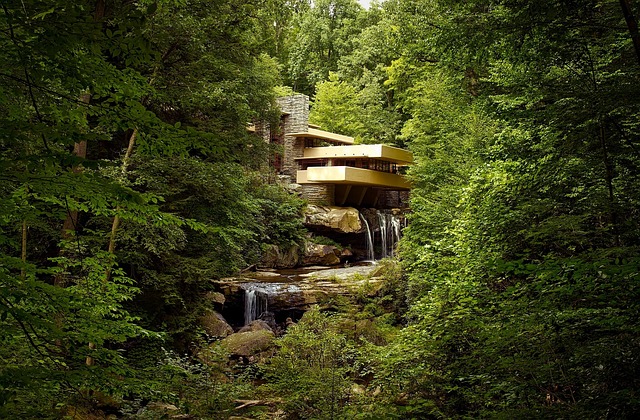
Origins and Principles of the Prairie Style
The Prairie Style grew from Wright’s pursuit of what he termed “organic architecture,” meaning buildings should grow naturally from their surroundings. He envisioned homes that blended into the Midwestern plains through long horizontal lines and low-pitched roofs. This horizontality echoed the vast prairie horizon, while open floor plans fostered social connection within domestic life. Materials such as brick and wood reinforced the link between structure and site, grounding the building in its physical context rather than imposing upon it.
Philosophical Foundations Behind the Design Ethos
Wright saw architecture as a living organism—an extension of human life rather than a static shell. The house was to be democratic, accessible, and spiritually nourishing. Rejecting ornate European historicism, he sought an American identity rooted in simplicity and honesty of materials. In his view, form should follow function not mechanically but poetically; spatial experience could elevate the spirit much like music or nature itself.
The Architectural Composition of Robie House
Robie House embodies these principles through structural daring and careful orchestration of space. Every element serves both practical needs and symbolic purpose.
Structural Innovation and Spatial Organization
The use of steel beams allowed Wright to create sweeping cantilevers that visually float above the base structure. This innovation liberated interior space from load-bearing walls, producing open plans where rooms interlock fluidly rather than being confined boxes. Continuous horizontal lines—roof eaves, window bands, brick courses—reinforce the sense of expansion outward into the landscape even within an urban setting.
Materiality and Craftsmanship in Robie House
Wright selected materials that expressed warmth yet precision: Roman brick laid in long horizontal joints, oak trim framing built-in furniture, art glass filtering sunlight into amber tones. These choices were not decorative but integral to the architecture itself. Custom-designed furnishings extended structural motifs into daily life so that furniture, lighting, and walls formed one continuous composition. The craftsmanship balanced industrial efficiency with hand-finished care—a dialogue between machine age progress and artisanal tradition.
The Expression of Prairie Ideals in Robie House’s Design Elements
Robie House translates abstract philosophy into tangible experience through its relationship to site, environment, and human movement.
Integration with Site and Environment
Though located on Chicago’s South Side rather than open prairie, the building still responds to natural forces. Its orientation captures prevailing breezes while deep overhangs temper sunlight across seasons. Terraces extend living areas outward so that indoor activities merge seamlessly with gardens. Landscaping is conceived not as ornament but as architectural continuation—the ground plane flows into masonry planes without abrupt boundaries.
Spatial Flow and Human Experience
Inside, movement unfolds gradually along axial paths that reveal space in layers rather than all at once. The central hearth anchors this flow both physically and symbolically as the heart of domestic unity. Public areas open around it while private zones recede upward or behind screens, creating subtle gradients of privacy without rigid partitions. This spatial choreography encourages interaction yet preserves intimacy—a hallmark of Wright’s residential design.
The Philosophical Completeness of Robie House Within Wright’s Vision
Robie House represents both culmination and transition within Wright’s early career: a near-perfect realization of his Prairie ideals yet already gesturing toward future organic masterpieces.
Realization Versus Idealization of the Prairie Concept
As an urban commission constrained by lot size and neighboring buildings, Robie House tested how far Wright could push his prairie vocabulary within city limits. The result achieves remarkable horizontality despite vertical context pressures—a triumph of proportion over circumstance. Yet compromises remain: reduced garden depth limits full landscape integration compared to rural counterparts like the Dana-Thomas House.
Symbolic Resonance Beyond Physical Form
Beyond its geometry lies moral conviction. For Wright, architecture was ethical expression—the built equivalent of democracy where openness mirrored social transparency. Spatial freedom equated to personal freedom; light-filled interiors suggested intellectual clarity. These ideas anticipate later works such as Fallingwater where nature becomes inseparable from structure but trace their philosophical roots directly back to Robie House’s disciplined harmony between man-made form and natural order.
Critical Perspectives on Whether the Philosophy Was Fully Realized
Scholars continue to debate whether Robie House achieved true organic unity or merely approached it through formal mastery.
Interpretations from Architectural Historians and Theorists
Some historians view it as prototype—a bold experiment still bound by early 20th-century conventions—while others regard it as consummate embodiment of Prairie principles before Wright turned toward more sculptural expressions in concrete and stone. Phenomenological readings emphasize sensory continuity between spaces; structuralist analyses focus on its tectonic logic; contextual critics highlight how it mediates between individual dwelling and urban grid.
Enduring Legacy in Modern Architectural Discourse
Robie House influenced generations of architects who pursued openness, horizontality, and environmental integration—from mid-century modernists like Richard Neutra to contemporary sustainable designers emphasizing site-specific response. Its lessons resonate today in discussions about energy-efficient envelopes, passive solar control, and biophilic design strategies that connect occupants emotionally with place. As both artifact of early modernism and living framework for architectural philosophy, it remains central to any study of frank lloyd wright prairie house evolution.
FAQ
Q1: What defines Frank Lloyd Wright’s Prairie Style?
A: It emphasizes horizontality, open floor plans, low roofs, natural materials, and strong connection between building and landscape inspired by Midwestern prairies.
Q2: Why is Robie House considered revolutionary?
A: Its structural use of steel beams created unprecedented open interiors while its integrated furnishings blurred boundaries between architecture and décor.
Q3: How does Robie House embody democratic ideals?
A: By rejecting ornamental hierarchy for spatial equality where every area contributes to communal life without ostentation or privilege markers.
Q4: What challenges did Wright face designing an urban Prairie house?
A: Limited lot size restricted garden integration; surrounding structures competed visually with horizontal emphasis requiring careful proportion control.
Q5: How does Robie House influence sustainable design today?
A: Its passive climate strategies—orientation for light control, deep eaves for shading—anticipate modern green building principles emphasizing harmony with environment.