
What is the style of the Chrysler Building and what makes it Art Deco?
The short answer
The style of Chrysler Building architecture is Art Deco, also described in historic preservation records as Style Moderne or modernistic. Designed by William Van Alen for Walter P. Chrysler and built between 1928 and 1930 at 405 Lexington Avenue in Manhattan, the 77-story tower became one of the clearest examples of New York’s late-1920s skyscraper boom. Its character comes from a combination of stepped massing, geometric ornament, stainless-steel surfaces, sunburst forms, automotive symbols, and a theatrical skyline profile.
The Chrysler Building is not Art Deco simply because it has decoration. It is Art Deco because its structure, materials, ornament, and corporate symbolism work together to communicate speed, height, industry, luxury, and modernity.
For readers comparing building styles, the Chrysler Building is a useful case study because it shows how Art Deco could be both ornamental and technically ambitious. It is neither a Gothic Revival tower nor an International Style glass box. It belongs to a period when architects wanted skyscrapers to look modern, vertical, machine-made, and recognizable from far across the city.
Why the Chrysler Building is considered Art Deco
The New York City Landmarks Preservation Commission, in its 1978 designation report, identifies the Chrysler Building as an outstanding example of Art Deco architecture. The National Park Service registration material classifies its style as Moderne and describes the building as an architectural expression of the machine age. These descriptions are not contradictory. In American architectural history, Art Deco, Style Moderne, and modernistic were often overlapping terms for design that used simplified forms, geometric ornament, rich materials, and imagery associated with modern industry.
The Chrysler Building fits that description unusually well. Art Deco was not a single formula. It was a design language that absorbed influences from the 1925 Paris exposition, modern industrial production, luxury craft, ancient and exoticized motifs, and the speed culture of cars, airplanes, and ocean liners. Van Alen translated those ideas into a skyscraper. Instead of masking modernity behind classical columns, he emphasized the tower’s vertical rise, metal surfaces, flush window frames, zigzag bands, triangular windows, and reflective crown.
One reason the building remains so convincing is that its Art Deco features work at several scales. At street level, the entrances are dramatic and polished. At the middle levels, brick patterns, spandrels, and automotive ornament give the facade texture. At the skyline, the stainless-steel crown and spire create a profile that is legible from a distance. That continuity from sidewalk to sky is central to the building’s style.
How Art Deco appears in the exterior design
Setbacks turn zoning into style
The Chrysler Building rises through a series of setbacks shaped by the 1916 New York zoning ordinance, which required tall buildings to step back so light and air could reach the street. Many Manhattan towers of the period share this stepped profile, but Van Alen used the requirement as a design opportunity. The building does not simply retreat as it rises; it appears to accelerate. Its mass narrows, its vertical lines become more pronounced, and the top seems to dissolve into metal, light, and sky.
This is a key Art Deco move. The massing suggests momentum rather than static weight. Earlier skyscrapers often treated the tower like a classical column with a base, shaft, and capital. The Chrysler Building is more dynamic. The eye moves upward across setbacks, striped brickwork, metal ornament, and finally the crown. That upward pull helps explain why the tower feels fast, even though it is made from steel, masonry, and stone.
Geometric ornament replaces classical detail
Art Deco often uses geometry in place of historical carving. On the Chrysler Building, the decorative vocabulary includes zigzags, chevrons, sunburst forms, triangular windows, horizontal bands, and stylized reliefs. These details are ordered and repetitive, but not plain. They make the facade active without returning to Greek, Roman, or Renaissance ornament.
The building’s black, white, and gray brick patterns are part of the effect. The Landmarks Preservation Commission report notes the use of contrasting brick, marble strips, metal spandrels, and patterned surfaces across the lower and middle setbacks. These choices create a crisp graphic quality that supports both verticality and speed. The result is decorative, but not soft or floral in the way Art Nouveau can be. Chrysler Building ornament is hard-edged, metallic, and architectural.
Materials express modernity
One of the most important features of the Chrysler Building style is its use of Nirosta stainless steel. Preservation reports describe Nirosta as a rust-resistant chromium-nickel steel associated with a German Krupp formula and used for exterior ornament, window and entrance framing, the dome, and the spire. The material gives the building its famous shine, but its role is more than cosmetic. In the 1920s, stainless steel signaled industrial progress, durability, and machine-age precision.
That is why the crown feels inseparable from the building’s identity. A stone crown would have produced a different kind of skyscraper. The reflective metal surface links the building to automobiles, chrome, and the polished imagery of speed. It also turns sunlight into part of the architecture.
Key style elements at a glance
| Feature | Where it appears | Why it matters to the style |
|---|---|---|
| Stepped massing | Throughout the tower | Connects New York zoning requirements with Art Deco vertical drama. |
| Nirosta stainless steel | Entrances, ornament, crown, and spire | Signals modern industry, shine, durability, and machine-age luxury. |
| Geometric patterns | Brickwork, spandrels, crown, and interior details | Replaces classical ornament with zigzags, triangles, bands, and sunburst logic. |
| Automotive motifs | Radiator-cap forms, hubcap imagery, racing-car frieze, eagle-like hood-ornament figures | Links the tower to Walter P. Chrysler, car culture, speed, and corporate identity. |
| Terraced crown | Top of the tower | Creates one of the most recognizable Art Deco skyline silhouettes in New York. |
| Rich lobby materials | Ground-floor interior | Extends the exterior’s Art Deco message into marble, metal, lighting, mural work, and elevator design. |
The Chrysler Building is not defined by one decorative feature. Its style works as a system: the massing, metals, motifs, and interior all support the same message of modern urban glamour.
The crown and spire define the building’s silhouette
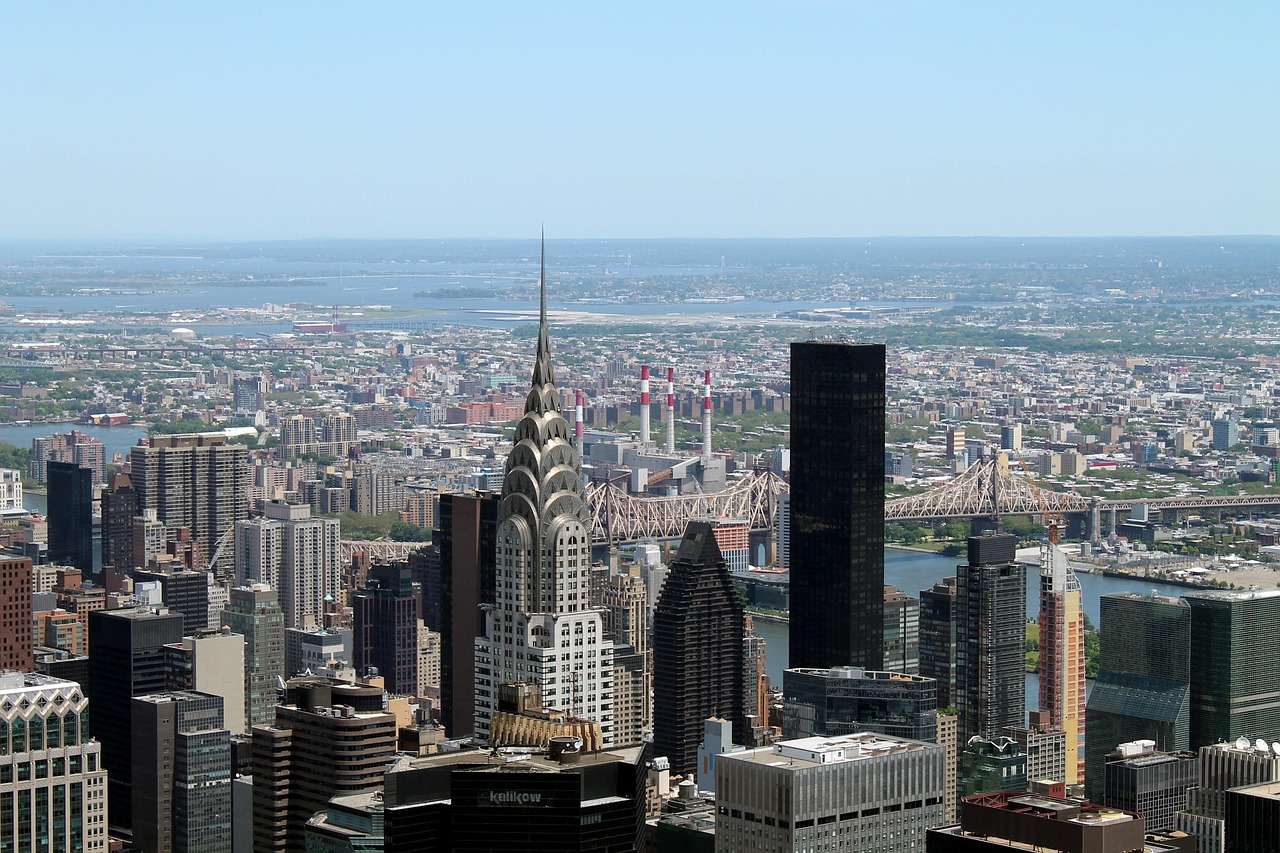
The Chrysler Building’s crown is the element most people remember first. It is formed by a series of terraced stainless-steel arches set with triangular windows, creating a sunburst-like pattern that looks both mechanical and celestial. The crown compresses several Art Deco ideas into one form: symmetry, radiating geometry, reflective material, upward motion, and theatrical display.
The spire made the design even more dramatic. Historic reports describe a 185-foot spire assembled within the upper part of the building and raised into position in late 1929 in about 90 minutes. This maneuver helped the Chrysler Building claim the title of world’s tallest building when it opened in 1930. The title was brief; the Empire State Building surpassed it in 1931. Even so, the episode reinforced the building’s image as an architectural event, not just an office tower.
Published height figures vary slightly by source, commonly appearing around 1,046 to 1,048 feet depending on measurement convention. The more important point for style is that height was treated visually. Van Alen did not rely on scale alone. He made the top memorable through material contrast, stepped geometry, and a spire that extends the upward movement beyond the occupied floors.
The crown also separates the Chrysler Building from many later skyscrapers. Modern glass towers often seek a smooth continuous surface. The Chrysler Building builds toward a climax. Its top is a decorative, symbolic, and structural finale, which is why the silhouette remains effective even in a skyline now filled with taller buildings.
Automotive ornament turns branding into architecture
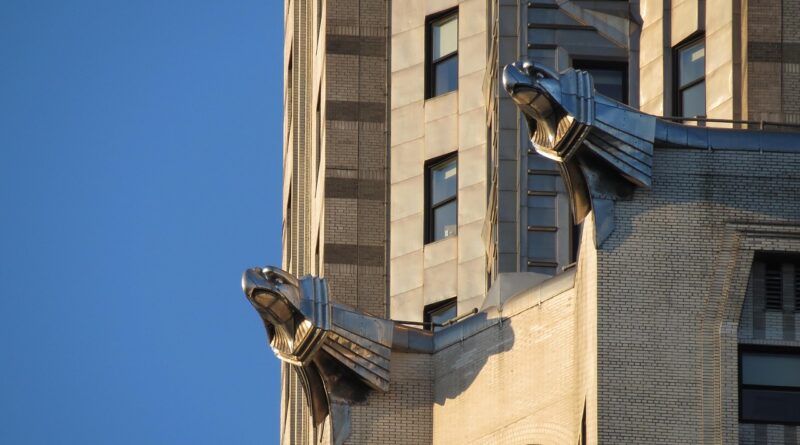
The Chrysler Building is an office tower, but its ornament is closely tied to automobile imagery. The Landmarks Preservation Commission report describes large ornamental Chrysler radiator caps at the thirty-first floor, a gray-and-white brick frieze with stylized racing automobiles and polished hubcap imagery, and Nirosta steel gargoyle-like forms at an upper setback. Many modern descriptions refer to the high projecting figures as eagles or as hood-ornament-like forms, which reflects how they read from the street: metallic, aerodynamic, and assertive. See also: Building Layout.
This branding is unusually architectural. It is not a flat sign applied to the facade. The radiator caps, hubcaps, racing cars, and metal creatures are built into the composition of the tower. They turn a corporate association into a complete visual program. That approach is strongly Art Deco because the style often celebrated modern commerce, travel, electricity, machinery, and mass production.
At the same time, the building does not read as a literal car showroom. The motifs are stylized and scaled up until they become architectural ornament. A radiator cap becomes a corner feature. A hubcap becomes part of a facade rhythm. The visual language is commercial, but abstract enough to remain compelling after the original corporate moment has passed.
The lobby continues the Art Deco language indoors
The style of the Chrysler Building is not limited to the exterior. Its ground-floor interior is also recognized as a major Art Deco space. The Landmarks Preservation Commission designated the exterior and the ground-floor interior in 1978, noting the importance of materials such as red Moroccan marble, Nirosta steel, lighting, and decorative elevator work. The lobby turns the machine-age message of the outside into a more intimate and highly crafted environment.
The interior matters because it shows another side of Art Deco. Outside, the building is about height, shine, speed, and skyline visibility. Inside, it is about richness, pattern, route, and theatrical arrival. The entrance lobbies and main concourse guide pedestrians through polished surfaces, angular forms, and elevator areas that feel carefully staged rather than merely functional.
The ceiling mural by Edward Trumbull is part of this program. Preservation sources describe the mural as depicting progress in transportation and construction technology as well as the Chrysler Building itself. That subject matter is important. The interior does not retreat into historical nostalgia. Like the exterior, it celebrates movement, building, labor, machines, and modern industry.
The elevator doors and cabs also contribute to the style. Their woods, patterns, and crafted surfaces show the luxurious side of Art Deco, while their geometric organization keeps them aligned with the building’s modern image. The lobby confirms that the Chrysler Building style is both industrial and decorative, both machine-like and hand-finished.
Art Deco, Style Moderne, or modernistic?
Readers often ask whether the Chrysler Building is Art Deco, Style Moderne, or simply modernistic. The most useful answer is that Art Deco is the clearest and most widely used label, while Style Moderne and modernistic are historically related terms that appear in preservation and architectural writing. The National Park Service metadata uses Moderne as an architectural style, while New York City’s landmark report discusses Art Deco and related terms such as Style Moderne.
These labels overlap because architecture of the late 1920s and early 1930s did not always fit today’s neat categories. The Chrysler Building has the geometric ornament and luxury materials associated with Art Deco. It also has the streamlined, machine-age, speed-oriented imagery associated with Moderne design. Rather than choosing one term to exclude the others, it is more accurate to describe the Chrysler Building as an Art Deco skyscraper with strong American Style Moderne and machine-age qualities.
What it is not
The Chrysler Building is not Gothic Revival, even though critics and historians sometimes compare its projecting metal figures to gargoyles on Gothic cathedrals. That comparison is about silhouette and function, not style. Gothic Revival architecture uses pointed arches, tracery, medieval references, and stone-like vertical ornament. The Chrysler Building uses modern metals, automotive symbolism, stylized geometry, and machine-age imagery.
It is also not International Style modernism. International Style buildings usually reduce ornament, emphasize volume over decoration, and favor glass, steel, and functional abstraction. The Chrysler Building is modern, but it is not minimalist. It treats ornament as essential communication. That difference is exactly why the tower remains such a useful example for anyone studying building styles.
Frequently asked questions
What architectural style is the Chrysler Building?
The Chrysler Building is an Art Deco skyscraper. Historic preservation sources also use related terms such as Style Moderne and modernistic, but Art Deco is the most recognizable and accurate general label.
Who designed the Chrysler Building?
The building was designed by architect William Van Alen for Walter P. Chrysler. It was built between 1928 and 1930 in Midtown Manhattan.
Why is the Chrysler Building an Art Deco icon?
It combines stepped skyscraper massing, geometric ornament, stainless-steel surfaces, automotive motifs, a dramatic crown, and a richly designed lobby. Few buildings integrate the Art Deco message so completely from street level to skyline.
Is the Chrysler Building still the tallest building in New York?
No. It was the world’s tallest building when completed in 1930, but it was surpassed by the Empire State Building in 1931. Its importance today is architectural and cultural rather than height-based.
What is the most recognizable Art Deco feature of the Chrysler Building?
The stainless-steel crown and spire are the most recognizable features. The terraced arches, triangular windows, and reflective metal surface create the building’s famous machine-age silhouette.