
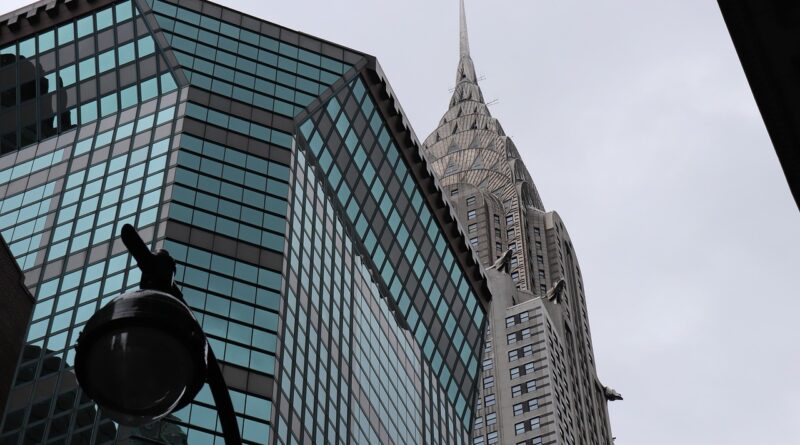
Chrysler Building facade and the Art Deco logic behind its crown
Why the Chrysler Building facade still matters
The Chrysler Building facade remains one of the clearest examples of how Art Deco architecture made a skyscraper legible from the sidewalk, the street grid and the skyline. Designed by William Van Alen for Walter P. Chrysler and built between 1928 and 1930 at 405 Lexington Avenue in Manhattan, the building uses brick, marble, granite, aluminum and Nirosta stainless steel to turn a steel-framed office tower into a vertical composition of speed, machinery and modern commerce. The facade is not only the famous shining crown. It is a staged sequence: a dark, polished base; a patterned brick shaft; dramatic setbacks; automotive symbols; eagle-head gargoyles; ribbed steel arches; triangular windows; and a spire that completed the tower’s race for height.
For readers studying building facade design, the Chrysler Building is still useful because it shows how materials, zoning, corporate identity and urban visibility can work together without reducing the facade to surface decoration.
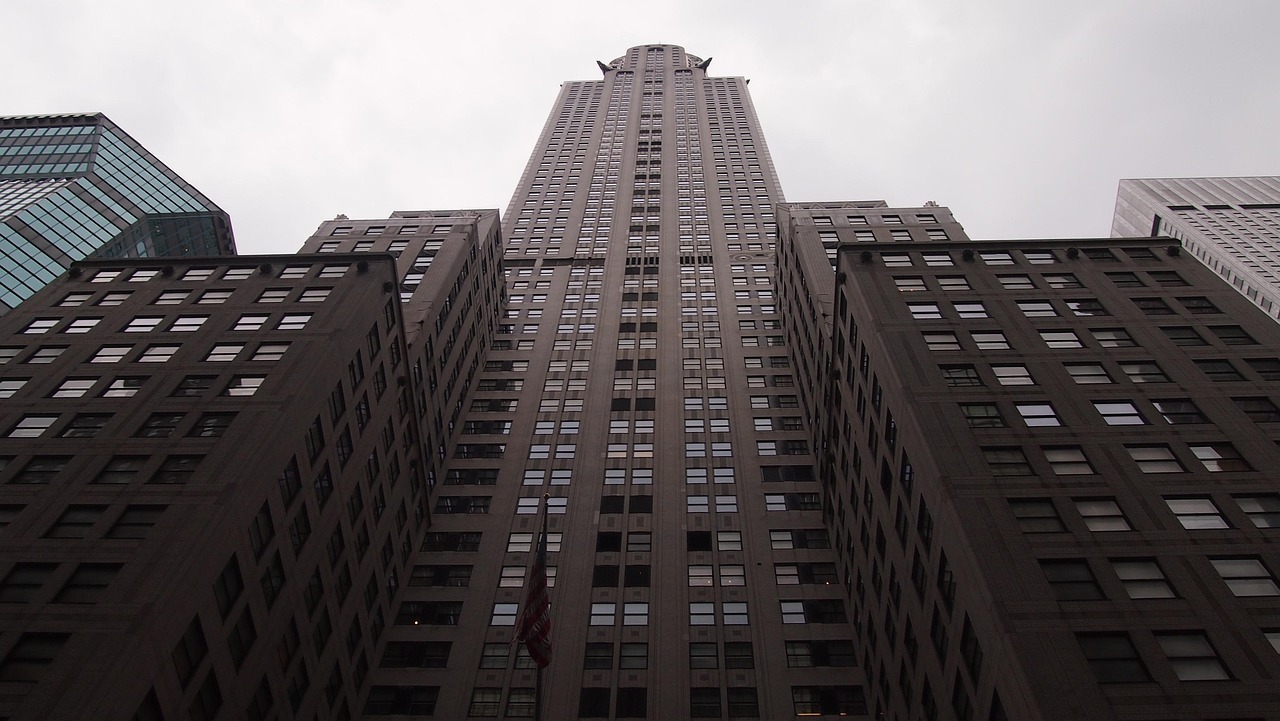
A facade shaped by height, zoning and visibility
The Chrysler Building rose during New York’s late-1920s skyscraper boom, when office towers competed for tenants, publicity and skyline dominance. The New York City Landmarks Preservation Commission’s 1978 designation report identifies it as a 77-story Art Deco skyscraper designed by Van Alen and built in 1928–1930. The National Park Service nomination records the height as 1,046 feet 4¾ inches from street level to the top of the pinnacle.
That height mattered, but the facade’s shape was not arbitrary. New York’s 1916 zoning rules encouraged tall buildings to step back as they rose, preserving light and air at street level. Van Alen turned that constraint into a design strategy. Rather than treating the tower as a simple base, shaft and capital, he distributed visual interest through the full height of the building. The setbacks become part of the architectural rhythm, pulling the eye upward while creating ledges for stainless steel ornament.
The result is a facade designed for several viewing distances. At the sidewalk, the granite, marble and metal entrances create a theatrical arrival. From several blocks away, the brick patterns and setbacks organize the tower’s mass. From the skyline, the Nirosta crown and spire make the building immediately recognizable. This layered readability is a major reason the Chrysler Building facade still works as both architecture and urban icon.
Material palette of the Chrysler Building facade
The facade combines masonry mass with metallic brightness. The National Park Service nomination describes the exterior as a contrast of enameled gray, white and black brick, with white Georgia marble, black Shastone granite, aluminum and Nirosta steel. The Landmarks Preservation Commission also emphasizes Nirosta, a rust-resistant chromium-nickel steel used for exterior ornament, window and entry framing, the dome and the spire.
This material palette is central to the building’s effect. Brick gives the tower depth, pattern and weight. Marble and granite create a refined urban base. Aluminum spandrels emphasize verticality. Nirosta steel adds brilliance, reflection and a machine-age character that connects the building to the automotive culture behind the Chrysler name.
| Facade zone | Main visual elements | Design role |
|---|---|---|
| Street base | Black Shastone granite, white Georgia marble, metal-framed entries and shop windows | Creates a dramatic commercial threshold and anchors the tower at street level |
| Lower stories to first major setback | White brick with marble strips in a basketweave-like pattern | Gives texture to the shaft and avoids a blank masonry surface |
| Setbacks around the 24th and 31st floors | Nirosta pineapples, radiator-cap forms, racing-car brick frieze and metal hubcap motifs | Turns setbacks into symbolic and ornamental events |
| Upper shaft | Grouped vertical window strips, brick framing, marble piers and black brick corner bands | Balances upward movement with horizontal banding |
| Crown and spire | Nirosta steel arches, triangular windows, eagle-head gargoyles and spire | Defines the skyline silhouette and concentrates the facade’s reflective power |
The material lesson is still relevant: the most memorable facade elements are not isolated from the building’s form. At Chrysler, the materials reinforce hierarchy. The darker base belongs to the street. The patterned brick belongs to the office tower. The reflective crown belongs to the skyline.
The crown is a facade system, not just an ornament
The crown is the part of the Chrysler Building most people remember, but it is often described too narrowly. It is not simply a shiny cap placed on a conventional tower. It is a facade system made of ribbed stainless steel arches, triangular windows and diminishing curves that make the top of the building appear to accelerate upward.
The Art Deco Society of New York notes that the crown is clad in approximately 4,500 plates of Nirosta and formed by seven concentric ribbed steel arches set with triangular windows. The Landmarks Preservation Commission report describes the polished dome and spire as the building’s most original and striking features, making the tower readable from a distance. In practical terms, the crown turns reflection into architectural mass. Daylight, weather and viewing angle all change how the metal reads, so the top of the building shifts in appearance throughout the day.
This responsiveness is one of the facade’s strongest lessons for contemporary architecture. The crown does not depend on a single image. It is animated by light, geometry and material finish, which gives it more lasting architectural value than a purely graphic pattern or applied sign.
Automotive symbolism in the facade
Because Walter P. Chrysler was closely associated with automobile manufacturing, the building’s facade uses automotive references with unusual directness. These references are not hidden details. They operate at urban scale.
- Pineapple-like forms at the 24th floor: The Landmarks Preservation Commission describes conventionalized Nirosta pineapples at the corners, approximately nine feet high.
- Radiator-cap ornaments at the 31st floor: Large Nirosta forms crown outward extensions at the corners. The designation report notes that these ornaments span about 15 feet.
- Racing-car frieze: Gray and white brick ornament at the 31st floor includes stylized racing automobiles with polished steel hubcaps.
- Eagle-head gargoyles: Near the upper setbacks, Nirosta eagle heads project from the tower, translating the medieval gargoyle into a machine-age skyscraper motif.
These details work because they are integrated into the building’s vertical sequence. The automotive motifs do not merely advertise a brand. They reinforce the themes of speed, movement, industry and modernity. The Chrysler Building facade shows how corporate symbolism can become architecture when it is scaled, materialized and placed within a coherent composition.
Brickwork and window rhythm below the crown
The crown receives most of the attention, but the brick facade below it is essential to the building’s success. Without the controlled masonry field, the crown would feel detached. Van Alen used brick patterning, window grouping and shifts in vertical and horizontal emphasis to prepare the eye for the dramatic top.
Through the lower setback, the facade uses white brick with marble strips in a basketweave-like pattern. Above that, piers of white brick alternate with vertical window strips, while aluminum spandrels help pull the composition upward. Around the 20th to 22nd floors, polished abstract relief ornament adds another layer of surface detail. Higher up, the shaft groups windows into vertical bands at the center of each face, while black brick creates horizontal banding at the corners. See also: Building Styles.
This is a careful balance. The facade never becomes a flat grid, but it also does not dissolve into uncontrolled ornament. The shaft remains disciplined enough to support the crown. The brickwork gives the eye a path upward, while the setbacks introduce moments of emphasis. In current facade design terms, it is a reminder that pattern, depth and hierarchy can be as important as material novelty.
How the spire completed the facade story
The spire is often discussed as part of the height race between the Chrysler Building and 40 Wall Street, but it also matters as the final gesture of the facade. The Landmarks Preservation Commission report states that Van Alen designed a 185-foot spire that was fabricated in sections, assembled secretly at the 65th floor and raised into position in November 1929 in an operation that took about 90 minutes. This engineering episode helped the building claim the title of world’s tallest when completed, although that distinction was short-lived after the Empire State Building.
Architecturally, the spire sharpens the crown’s upward motion. The building does not simply stop; it tapers into a point. The effect is both technical and theatrical. The spire extends the language of the facade beyond the occupied office floors and turns the tower into a skyline instrument. It also shows how structure, publicity and architectural form were tightly connected in the skyscraper culture of the period.
Preservation value and lessons for modern facade design
The Chrysler Building was designated a New York City landmark in 1978, and its significance was also recognized in the National Register and National Historic Landmark framework in the 1970s. Those designations matter because the facade is not merely famous; it is historically and materially specific. Its appearance depends on the relationship between masonry, metalwork, ornament and skyline form.
The Nirosta steel has also become part of the building’s technical legacy. The Art Deco Society of New York summarizes historical evaluations in which the stainless steel was inspected over several decades and showed very limited deterioration. That does not mean the facade is maintenance-free, but it does help explain why the crown still reads with such clarity nearly a century after construction.
For contemporary architects and facade consultants, the Chrysler Building offers several practical lessons:
- Make the facade legible at more than one scale. A successful tower facade should work from the sidewalk, from adjacent streets and from the skyline.
- Use ornament structurally within the composition. Chrysler’s ornaments mark setbacks, corners and transitions rather than floating randomly on the surface.
- Let materials express different roles. Masonry, stone, aluminum and stainless steel each carry a specific visual function.
- Design for light and changing perception. Reflective metal and triangular glazing make the crown responsive, not static.
- Connect symbolism to form. The automotive references are memorable because they are integrated into the building’s massing and vertical rhythm.
The broader lesson is that facade design can communicate identity without becoming superficial branding. At Chrysler, the facade tells a story of commerce, speed, engineering and urban ambition through architectural means.
Frequently asked questions
What is the Chrysler Building facade made of?
The facade uses a steel frame with brick facing, plus white Georgia marble, black Shastone granite, aluminum and Nirosta stainless steel. Nirosta is especially important at the crown, spire, window and entry framing, and major ornaments.
Why is the Chrysler Building crown so famous?
The crown is famous because it combines reflective Nirosta steel, concentric ribbed arches and triangular windows into a skyline form that is visible from far beyond the site. It is both a material innovation and a compositional climax.
Are the Chrysler Building gargoyles really eagles?
Yes. The upper projecting ornaments are commonly described as eagle-head gargoyles. They reinterpret the traditional gargoyle as an Art Deco, machine-age form and are made of Nirosta stainless steel.
How does the facade relate to Chrysler automobiles?
The facade includes stylized references to radiator caps, hubcaps, racing cars and hood-ornament-like forms. These details connect the tower to Walter P. Chrysler’s industrial identity while supporting the Art Deco themes of speed and modernity.
Why is the Chrysler Building facade important today?
It remains important because it demonstrates how facade design can integrate structure, zoning setbacks, material innovation, corporate symbolism and skyline identity. Few skyscrapers show that combination as clearly or as memorably.